Lesson 1: Your gut needs a training plan too
Sawe averaged 115 grams of carbs per hour during the London Marathon using Maurten's hydrogel products.
That's nearly double the 60 grams per hour that was considered the absorption ceiling for decades.
Research from Maurten's sports science team found that consuming 120g of carbs per hour requires 2.6% less oxygen demand compared to the traditional 60g threshold.
But here's the part that matters for you: Sawe's stomach didn't learn to handle that on race day.
It took Sawe over 12 months to develop and test his protocol, progressively conditioning his gut to absorb aggressive carb loads without distress.
Kejelcha took roughly 60ml of fluid at most stations, skipped his 5K bottle, and took nothing at 40K.
He still ran 1:59:41. But he faded slightly over the final kilometers while Sawe accelerated.
You don't need 115 grams per hour. For a 3:00 to 5:00 marathon, 60 to 90 grams per hour using a glucose-fructose gel or drink mix is the practical range.
The practical takeaway:
Start practicing your exact race-day fueling during long runs at least 8 weeks before your goal race.
Begin with 30 to 60g of carbs per hour and increase by 10 to 15g per week as your gut adapts.
The lesson from Sawe is the process, not the number.
Lesson 2: The greatest negative split in marathon history
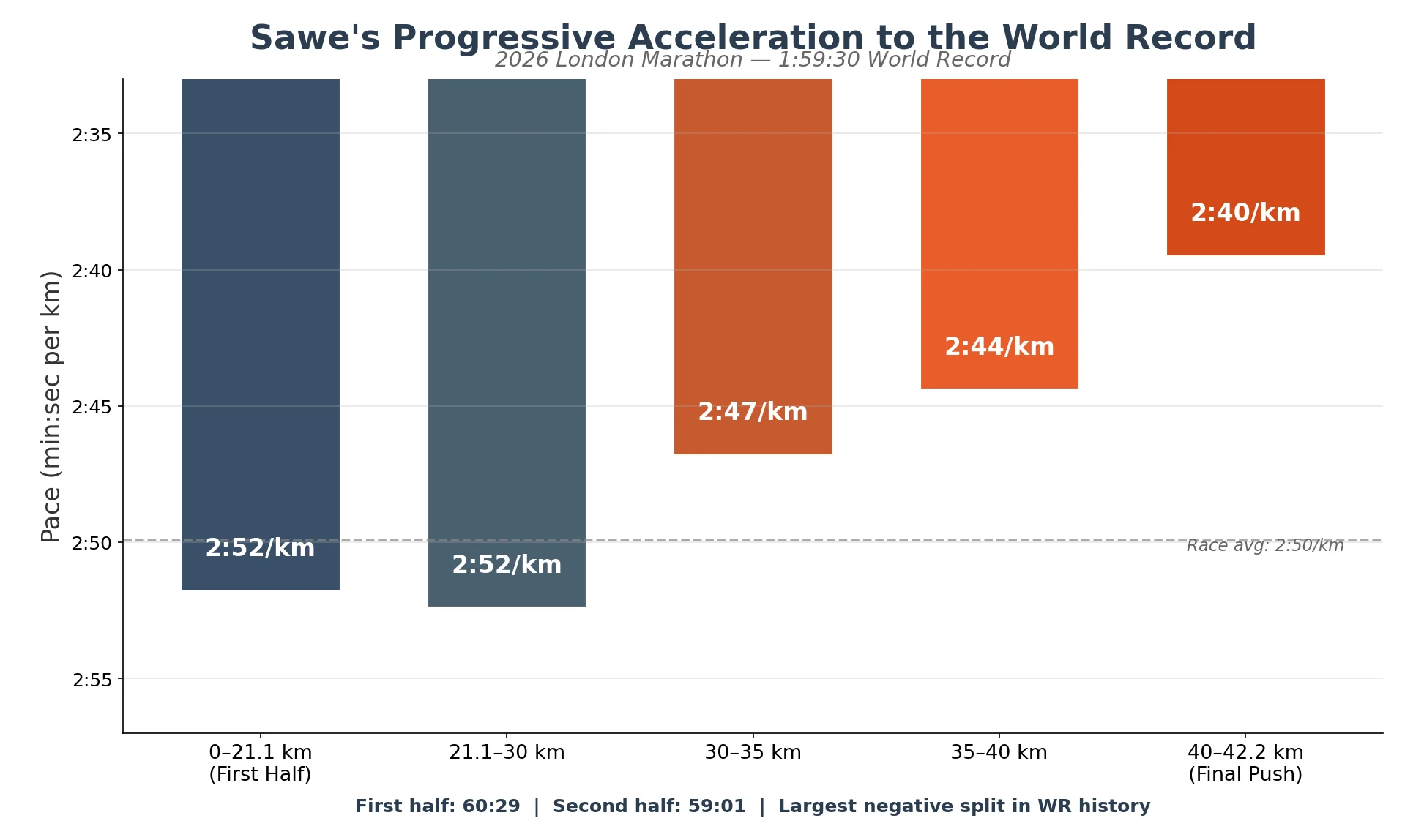
Sawe didn't run the fastest first half in marathon history. He ran the fastest second half.
Official race data shows he passed halfway in 60:29, then ran the second half in 59:01 for the largest negative split in marathon world record history.
His final 12.2K were run at progressively faster paces: a 5K split of 13:54 (1:57:18 marathon pace), followed by 13:42 (1:55:40 pace), and a closing 2.2K in 5:51.
He made his decisive move with 1 mile remaining and finished alone.
A physiological analysis of negative split pacing found that starting conservatively reduces early glycogen depletion and limits lactate accumulation, preserving muscular efficiency and delaying central fatigue.
The practical takeaway:
The practical translation is straightforward: when you start slower than your body wants to go, you arrive at mile 18-20 with more fuel in the tank and less metabolic damage to fight through.
Most runners do the opposite.
Race-day adrenaline pushes the first few miles 15-30 seconds per mile faster than goal pace, which burns through glycogen stores at a rate the body cannot sustain for 26.2 miles.
Use a race-day pacing calculator to plan your mile-by-mile splits before you get to the start line, and commit to running the first 5K at 5-10 seconds per mile slower than your goal pace.
Sawe had the fitness to run 59:01 for a second half because he did not waste energy running 58:30 for the first.
The same principle applies at 3:30 or 4:30 marathon pace.
A negative split training approach teaches your body and your brain to trust a conservative start, and the payoff comes in the final 10K when the runners around you are slowing down and you are speeding up.
Lesson 3: 220 km/week vs. 120 km/week, same result
Sawe averaged 220 km per week during his 3-month training camp, peaking at 241 km in his heaviest week.
Kejelcha trained at 120 to 140 km per week.
Two runners broke 2 hours on the same day with training volumes that differed by nearly 100 km per week.
Sawe's approach was high-volume: 9 to 10 consecutive training days before a rest day, with his coach adjusting the plan based on how his body responded rather than following a fixed schedule.
Kejelcha compensated for lower volume with superior raw speed built over years of track racing. He held the half marathon world record at 57:30 before running his first full marathon, which means his running economy and VO2max were already among the highest ever measured.
The practical takeaway:
For most runners, the takeaway is not to chase a specific weekly mileage number.
Consistency across months matters more than any single peak week.
A runner who averages 50 km per week for 16 straight weeks will almost always outperform a runner who alternates between 70 km weeks and 30 km weeks because of injuries or burnout.
Build your mileage to a level you can sustain without missing sessions, and invest the remaining training energy into the quality of your key workouts rather than adding more easy kilometers.
Lesson 4: What actually makes super shoes work
Both men raced in the Adidas Adizero Adios Pro Evo 3, a 97-gram shoe that became the first sub-100-gram racing shoe ever produced.
4 of the top 5 male finishers wore the same model, and Tigist Assefa set the women's world record in it on the same day.
Independent testing measured a 1.6% improvement in running economy over the previous version, driven by a new foam that is 50% lighter and delivers 11% more energy return.
The shoe doesn't use a traditional carbon plate. It uses a carbon-fiber ENERGYRIM that wraps around the perimeter of the midsole in a U shape, providing stiffness while maximizing the amount of foam under the foot.
The foam and how it interacts with the carbon structure is where the real efficiency gains come from.
Your Takeaway
For a runner targeting a four-hour or five-hour marathon, shoe technology researchers have found that the bigger contribution comes from modern PEBA foam, which is now available in shoes priced well below the $500 price tag of the Evo 3.
You do not need the lightest or most expensive racing shoe to benefit from this technology.
A mid-range carbon-plated shoe with quality PEBA foam in the $150-250 range delivers most of the efficiency gain at recreational pace, and studies have shown the benefit extends all the way down to 10-minute-per-mile pace.
Lesson 5: 4 strength sessions a week alongside 220 km of running
Sawe completed strength and conditioning sessions plus dedicated physiotherapy work 4 times per week throughout his training block.
This wasn't a supplement to his running. His coach Berardelli built it into the core structure of the program alongside the 220 km of weekly volume.
Strength work improves running economy by increasing the stiffness of the muscle-tendon unit, which means each ground contact returns more energy with less metabolic cost.
It also reduces injury risk by building the structural capacity to handle high training loads week after week.
The practical takeaway:
Most runners either skip strength training entirely or treat it as an afterthought on easy days.
You do not need four sessions per week to see a meaningful improvement.
Two to three sessions of 20-30 minutes focused on single-leg exercises, hip stability, and calf and foot strength will produce noticeable changes in how your legs feel during the final miles of a long run within 6-8 weeks of consistent work.
Lesson 6: Why flexible plans beat rigid ones
Sawe was injured through autumn 2025 and didn't begin real training until January 2026, roughly 4 months before London.
His original goal was to defend his London title. Breaking the world record wasn't the plan.
Instead of forcing his way back to full training on a fixed schedule, his coach Berardelli designed a reactive program that adjusted based on how Sawe's body responded from one training block to the next.
He trained 9 to 10 consecutive days, then took a rest day, breaking from the standard 7-day cycle entirely. Physiotherapy 4 times per week addressed lingering effects of his injury and allowed the training load to stay high without accumulating structural damage.
The practical takeaway:
This is the opposite of how most runners handle a disrupted training cycle.
The typical response to missed weeks is to compress the remaining plan and try to make up lost fitness by cramming in the sessions that were skipped.
That approach leads to a second injury or a state of accumulated fatigue that shows up as a bad race.
When your training block gets disrupted, adjust the plan to match your current fitness rather than the fitness you planned to have.
Shorten the buildup, protect the key workouts, and let go of the mileage targets that no longer reflect where your body actually is.
Sawe ran the fastest marathon in history on a four-month buildup that started with an injury and never followed a textbook plan.
Final Thoughts
Sawe and Kejelcha reached the same historic result through opposite paths.
You don't need to copy either one. Pick the lesson that addresses the weakest link in your current training, and apply it to your next cycle.
If you want the full breakdown of all 6 lessons with the research links and fueling protocols, read the complete article here.