What actually slows down after 50+ (it's not what you think)
Research on masters athletes confirms that older runners retain the ability to perform high-intensity intervals and show similar relative improvements from that training compared to younger athletes.
This specific study shows that cardiovascular function and muscle adaptability hold up far longer than the "just rest more" advice implies.
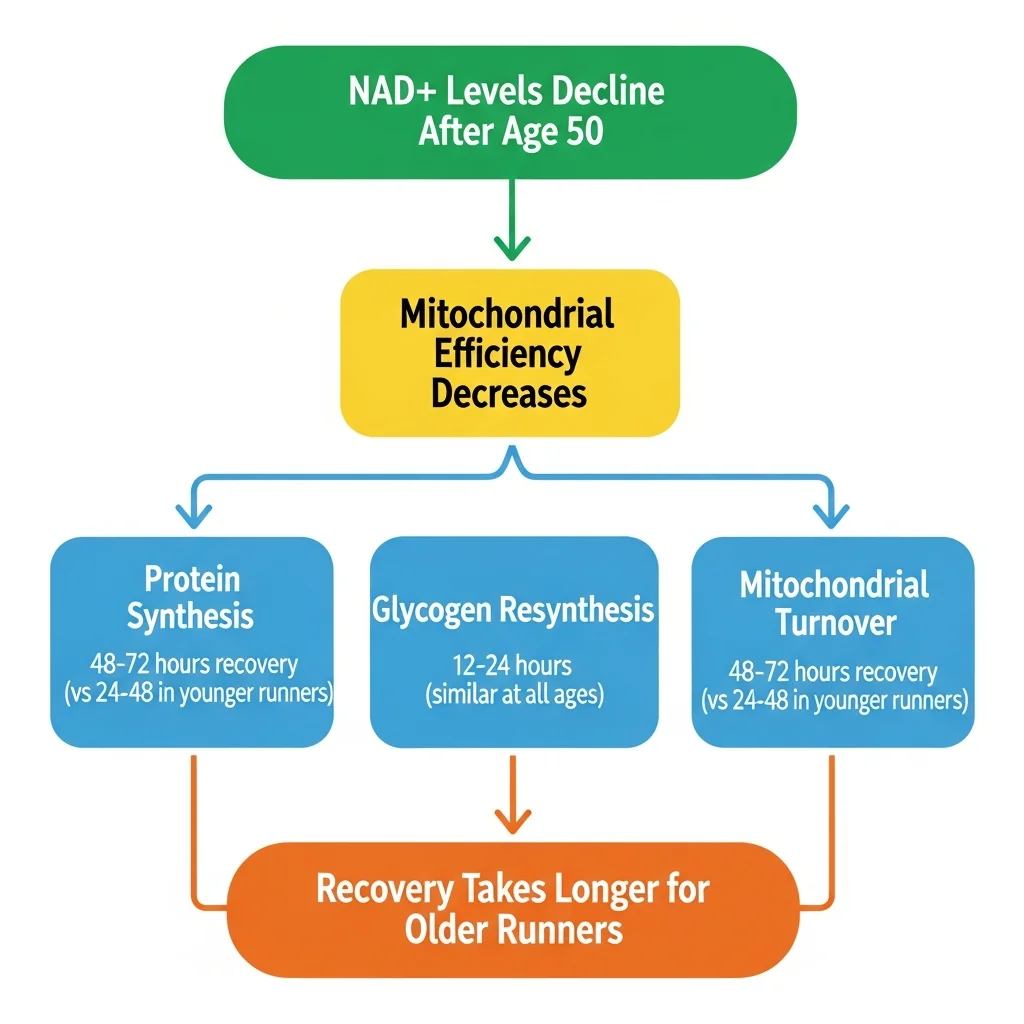
What actually changes is the machinery inside the cells, specifically a molecule called NAD+.
NAD+ is a molecule that powers mitochondrial energy production: the engine inside your muscle cells that converts food and oxygen into usable power.
Research has shown that healthy aging and muscle function are positively associated with NAD+ abundance in humans.
After age 50, NAD+ levels drop significantly.
When that happens, your mitochondria become less efficient at processing the training stimulus you created. Here's a full breakdown of NAD+ impacts performance.
Three specific recovery processes slow down:
- Protein synthesis (building new muscle fibers)
- Glycogen resynthesis (refilling fuel)
- Mitochondrial turnover (replacing old, damaged energy factories).
Younger runners complete all three in roughly 24 to 48 hours with adequate sleep and nutrition.
Older runners need closer to 48 to 72 hours for the same adaptations to settle in.
Your body can still adapt to hard training. The adaptation just takes longer, and gets disrupted more easily when recovery is rushed.
The recovery clock: what's different and what isn't
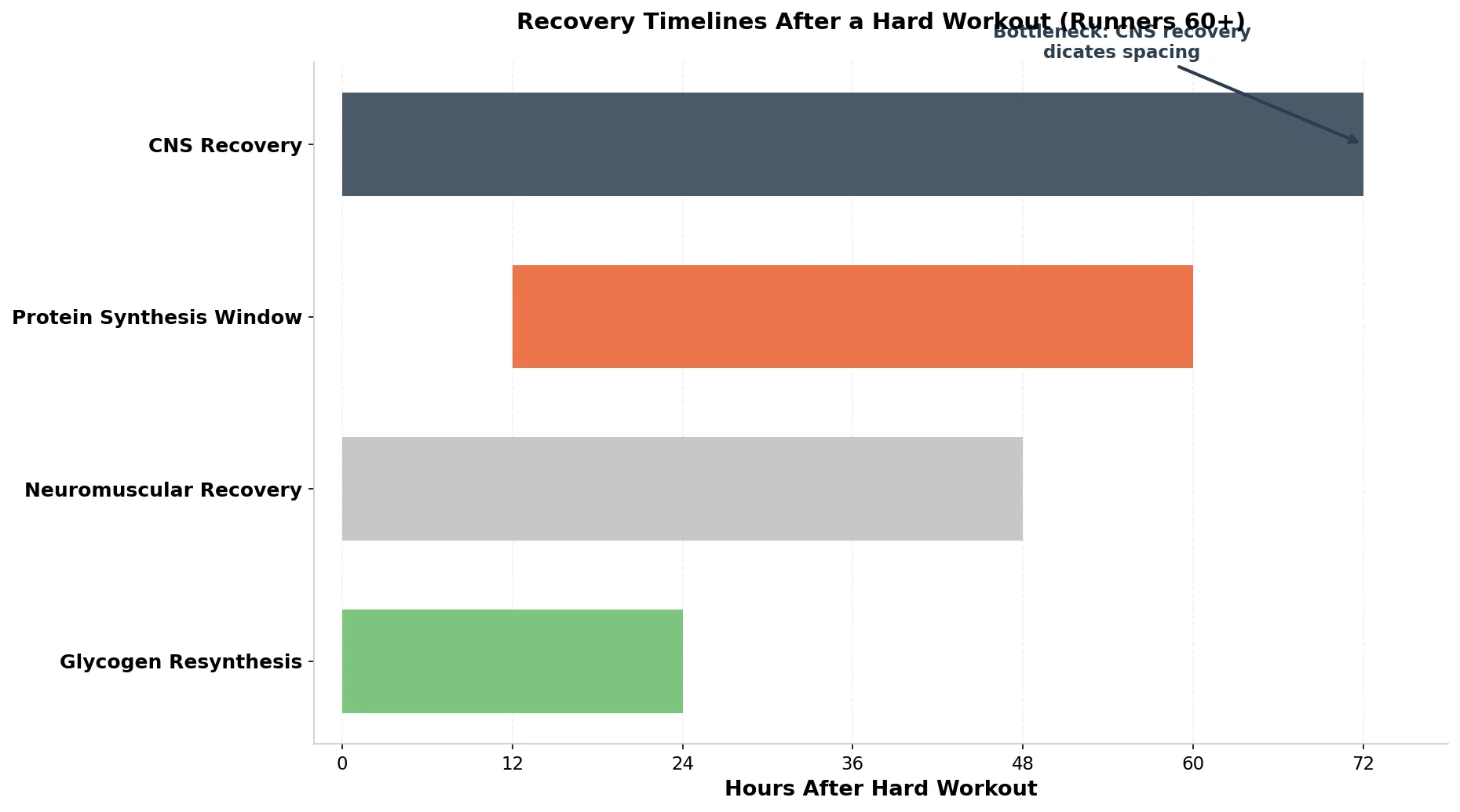
Neuromuscular fatigue (the heaviness and reduced power output after a hard effort) peaks around hour 24 and clears by hour 36 to 48.
That timeline is roughly the same as in younger runners.
Glycogen recharges just as fast in older runners: about 12 to 24 hours with adequate carbohydrate intake. That part hasn't changed.
The protein synthesis window is where things diverge.
In younger runners, muscle repair starts 4 to 6 hours after a hard workout. In older runners, that window doesn't open until about hour 12.
It stays open for 48 hours instead of 72.
Which means your body is still building from yesterday's workout while you're running today.
An easy run in that window is fine. Another hard session interrupts the building process before it's finished.
The real limiter, though, is the central nervous system.
Your CNS manages force output, coordination, and pace regulation.
When you tax it hard, it needs 48 to 72 hours to fully recover in older runners.
Back-to-back hard days hit the CNS harder than they slow protein synthesis, which is why spacing matters more than the number of rest days you take.
You don't have to give up quality
VO2 max declines with age, but the decline is almost entirely in your aerobic ceiling. Your ability to work at high percentages of that ceiling stays intact.
A 65-year-old runner can still do a 400-meter repeat at 95% of max heart rate. The max heart rate is lower, but the intensity percentage stays similar.
Thus, the quality if your running workouts doesn't need to change.
2 well-executed VO2 max or threshold sessions, spaced properly, produce more adaptation than 3 mediocre hard workouts squeezed around poor recovery.
The practical takeaway
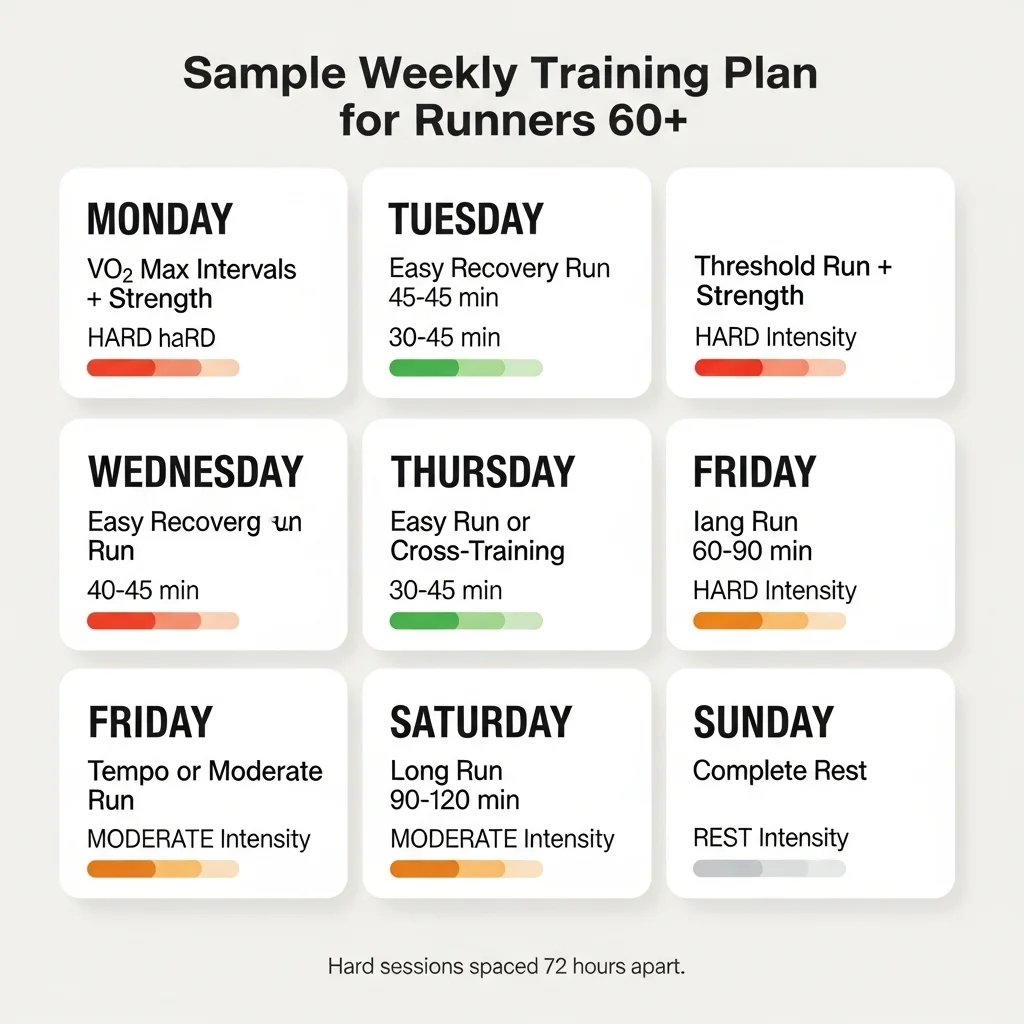
Keep your hard days. Space them at least 72 hours apart. Spacing is the mechanism that makes adaptation happen at this stage.
The 4-to-5 day sweet spot
Research on healthy longevity in older adults consistently points to exercise frequency and recovery spacing as the key variables, not total volume.
For runners 60 and older who are already established in their training, 4 to 5 days per week is the target.
Enough stimulus to maintain and improve fitness. Enough space between sessions for adaptations to complete.
The structure that works for runners 60+ in this range:
How to recover faster: Sleep and protein
Protein and carbs give your body the raw materials to complete each recovery process.
But the timeline of recovery is set by the spacing of your workouts and sleep.
Protein matters more for older runners because your muscles are less responsive to the training signal (called anabolic resistance), so you need adequate amino acids available when the adaptation window opens.
Aim for 25 to 30 grams of protein within a few hours after your hard workouts.
Carbohydrate refueling works the same at 65 as at 35.
Run hard, refuel with carbs within 30 to 60 minutes, and your glycogen stores recharge on schedule.
Sleep is the single most powerful recovery tool you have, and the one runners in their 60s are most likely to shortchange.
Fragmented sleep and shorter total sleep duration are common after 50.
Even a 6-to-7-hour commitment beats 5 hours for recovery quality, and the gap between those two numbers gets larger as you age.
If you struggle with getting consistent, deep sleep then check out our in-depth article on the science of better sleep.
How to know when you're doing too much
Overtraining in older runners shows up as persistent fatigue despite sleep, elevated resting heart rate (10+ bpm above your normal baseline), mood changes, and soreness lasting beyond 48 hours.
The resting heart rate signal is the most reliable one you have.
Measure it 5 mornings in a row during a normal week: first thing after waking, before getting up.
Establish your baseline (say, 58 bpm). Then watch for sustained elevation above that.
10+ bpm elevated means your nervous system is still fatigued from previous training.
When that happens, the fix is spacing.
Reduce the intensity of one session, or add a full rest day. Cutting total mileage while keeping back-to-back hard days usually won't solve it.
You have a smaller recovery budget than a 30-year-old. Treat it like a budget: allocate the hard efforts carefully, and the return on investment stays high.